Floral feast in the spring Garden
Now is a great time to visit two of our feature gardens, enjoy some flowering gems and say hello to their pollinating birds and insects.
Hibiscus brackenridgei subsp. mokuleianus
This is one of seven native species of Hibiscus in Hawaii. There are two subspecies of H. brackenridgei and each of these grow on separate islands. Subspecies mokuleianus is a small tree up to 5 metres that grows in lowland dry habitats with bright yellow flowers. It is now only found on one island and it is estimated that less than 70 mature plants remain. It is listed as critically endangered, threatened by invasive plants and animals. Family: Malvaceae
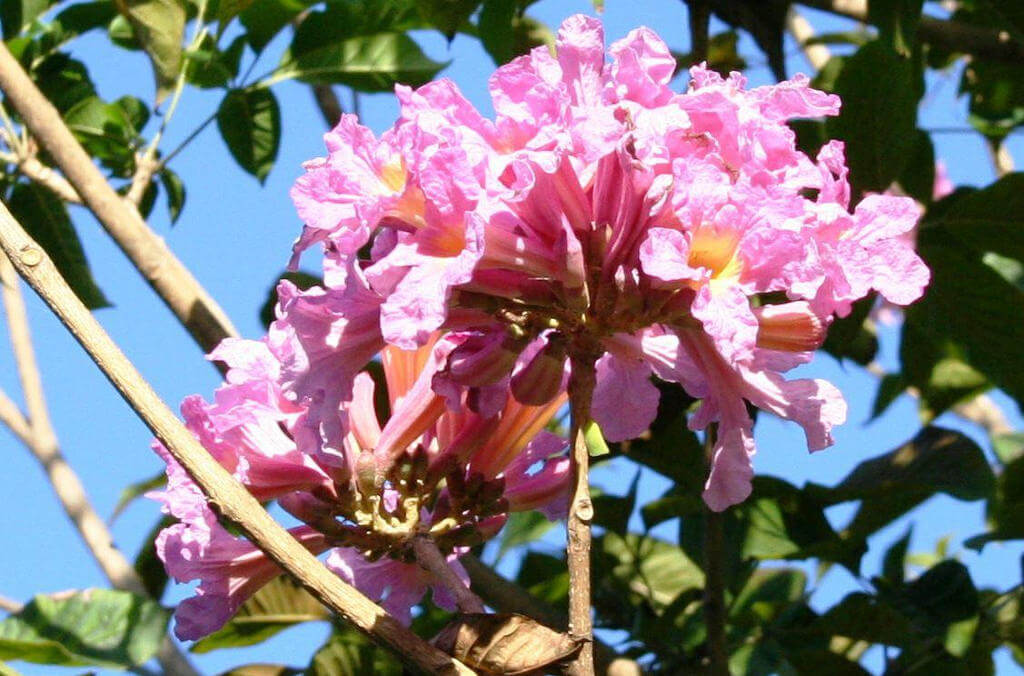
Pink Trumpet Tree - Handroanthus impetiginosus
A tree distributed from northern Mexico to northern Argentina, it is the national tree of Paraguay. A deciduous tree, it is spectacular in spring when the masses of large, pink trumpet like flowers emerge before the foliage and attract many
pollinators. The timber is used to make flooring and decking, and it has been used in traditional medicine. Logging of this species is known to contribute to deforestation of the Amazon. Family: Bignoniaceae
Gulgadya (Gadigal), Grass Tree - Xanthorrhoea sp.
Endemic to all states and territories in Australia, there are 28 species of grass trees. They are generally slow-growing and long-lived. The trunk, or caudex is made from old leaf bases that develop beneath the crown and protect the growing tip from fire. Flowers form on a spear-like spike that can be up to 4 metres long. The individual small white flowers are spirally arranged
and rich in nectar, making them popular with birds and insects. In many species flowering is stimulated by fire. Family: Asphodelaceae
Maiden's Blush - Sloanea australis
This rainforest tree is endemic to the east coast of Australia, from Bateman’s Bay (southern New South Wales) to Cape Tribulation (far north Queensland). It is widespread in sheltered creeks and gullies and can grow to 30 metres, with a buttressed and sometimes crooked trunk. The common name refers to the colour of the heartwood, which is pinkish and said to resemble a maiden’s blush. Creamy white flowers appear in spring followed by woody fruit that is eaten by rainforest birds. Family: Elaeocarpaceae
Tree Waratah - Alloxylon flammeum
This species from the Atherton Tablelands in northern Queensland grows in tropical rainforest, reaching over 30 metres in height. They are known for their spectacular bright red to orange flowers that resemble the flowers of the floral emblem of New South Wales, the Waratah. The fruit are woody rectangular seeds pods that contain eight to 10 winged seeds, spread by wind. Family: Proteaceae
The Rose Garden
Roses have a long history as symbols of beauty and love, but also war and politics. Most rose species are native to Asia, with a few from North America, Europe, and northwest Africa. This is the ninth Rose Garden created in the Garden’s history and contains a collection of striking modern roses cultivated with the minimal use of chemicals. Look out for the standard forms of perennial favourite Mr Lincoln. Family: Rosaceae
Banda (Gadigal), Dwarf Apple - Angophora hispida
This close relative of the Sydney Red Gum (Angophora costata) is a mallee, with multiple, often contorted trunks growing to around seven metres high. Its native habitat is confined to the Sydney region where it grows on Hawkesbury sandstone. Clusters of red flower buds are now appearing covered in hairs. Unlike species of eucalyptus and corymbia, angophoras do not have a protective lid or operculum on the bud. Family: Myrtaceae
The Australian Rockery Garden
This rockery features just some of the over 24,000 known species of Australian native plants, many of which are endemic to Australia. This is a great place to explore the variety and form of Grevilleas and their cultivars, as well as see some unique plants from Western Australia, many of them grafted so they can grow in Sydney's humid and wet conditions. On show at this time of year are Kangaroo Paws, Gymea Lilies, Emu Bush, Rice Flowers and Everlasting Daisies. This garden was created for the Sydney 2000 Olympics.
See the Garden this month
Our guided walks are the perfect way to experience the very best of the Garden.